Upper vs Lower Antelope Canyon: Which Should You Visit?
For most able-bodied travelers, Lower is the better all-around choice in 2026 — cheaper, longer, more adventurous, with easier handheld photography. Upper wins on one thing only: the famous vertical light beams (and step-free access). Here's the full side-by-side, and how to do both in one day.
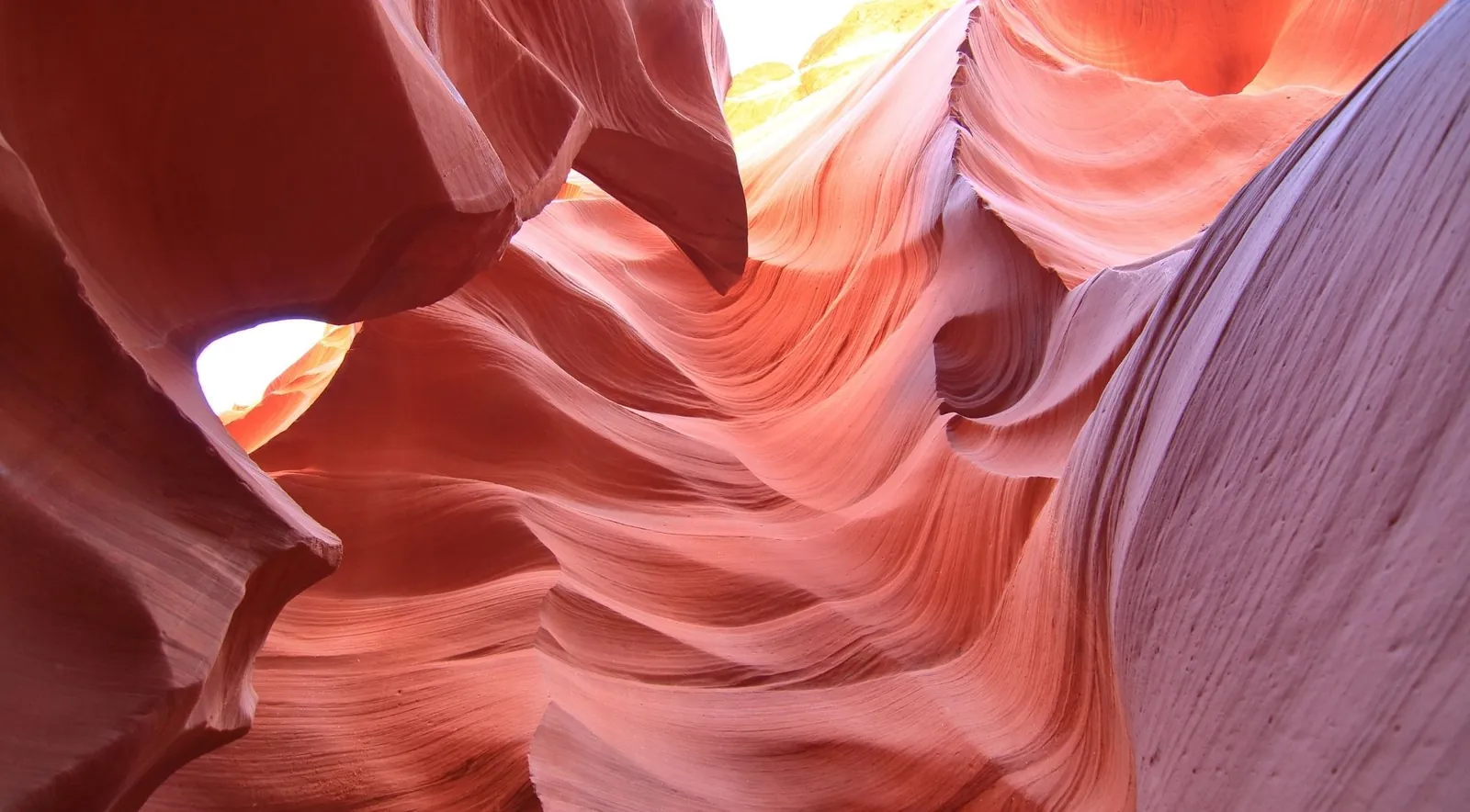
Antelope Canyon, Navajo Nation near Page, Arizona · Photo: editorial
Live availability · Upper and Lower Antelope Canyons Guided Tour
Both canyons sit on Navajo Nation land in the LeChee Chapter just east of Page, accessible only with a licensed Navajo guide. The same rules apply to both: the $15 per-person permit, the no-bag and no-tripod policy, and the flash-flood weather-cancellation system. The differences are shape, price, difficulty and light.
Upper Antelope vs Lower Antelope — side by side (2026)
Upper Antelope
Lower Antelope (Hazdistazí)
Shape
A-shaped — narrow opening above, wider at floor
V-shaped — narrow at floor, wider opening above
Length
~660 ft (200 m)
~1,335 ft (407 m)
Access
Flat sand floor, ground-level walk-in
5 flights of stairs down, 8 ladders/stairs up
Light beams
Famous — vertical shafts 11 AM–1:30 PM, late March–early October
Rarely — but bright, even glow throughout the day
Price (adult, all-in)
~$100–135+ (from $92 base)
$80.50 (from $75 on GetYourGuide)
Operators
Four Navajo-licensed operators
Two only — Ken's Tours & Dixie Ellis'
Best for
Light-beam photos · step-free access · families with toddlers
Live availability from GetYourGuide — more Navajo-guided canyon tours, Horseshoe Bend trips and Page-area day trips, picked automatically for this page.
Price comparison (2026)
Lower Antelope is significantly cheaper. Both Lower operators charge $80.50 per adult all-in (taxes, fees and the Navajo permit included), with children under 7 free at Dixie Ellis'. Upper Antelope starts at $92 base fare before the permit and fees — landing around $100–135+ all-in, with prime-time midday slots costing the most.
Lower (Ken's / Dixie's)$80.50 all-in
Upper (standard)$100–135+
Upper prime-time premium+$20–30
Navajo permit$15 / person
Lower Antelope — two operators, near-identical prices
Ken's Tours (lowerantelope.com) — General Tour with a "Starting price… $80.50 (includes taxes & fees)" per its official site. It also runs a Deluxe Tour ($173.63), a Combination Tour (from $148) and an 8.5-hour Premier Tour ($319.39). Historically a discounted winter rate of around $67.61 has been available in January–February.
Dixie Ellis' Lower Antelope Canyon Tours — $80.50 per adult, children under 7 free, with all fees, permits and taxes included.
Upper Antelope — four operators, and they don't price alike
Upper Antelope Canyon authorized operators (2026 base fares)
Operator
Price
Notes
Antelope Canyon Tours by Roger / Carolene Ekis
From $92 (ages 8+) $87 child (0–7)
Plus the $15 Navajo permit (ages 8+) and card/booking fees at checkout. Schedule: "9:00 AM, (**)11:20 AM, 1:40 PM & 4:00 PM **the 11:20am is priced higher (due to supply and demand)."
Antelope Slot Canyon Tours by Sarah Tsosie
From $95 adult (12+) $90 child (6–11) $85 military/veteran
The 11:40 AM prime-time slot carries the premium, and the same price is charged for children and infants.
Adventurous Antelope Canyon Tours
From $120
No children aged 0–7. Runs smaller groups than the others.
The Navajo Nation entry fee is, per Navajo Nation Parks & Recreation, "Entry Fee $15 per person, per location, per day" — bundled into your tour price. Do both Upper and Lower on the same day and you pay the permit only once; keep your receipt.
Why Upper costs more: it's shorter and smaller, so operators move fewer people per day; it's far more famous because of the light beams; and demand for midday beam slots is intense, supporting a roughly $20–30 prime-time premium — Antelope Canyon Navajo Tours, for example, charges $20 more for its 11:40 AM slot.
Photography tours are no longer offered at Upper or Lower — the Navajo Nation discontinued them, with the last photographer tours at Upper running in 2019 and Lower's ending around 2018. They survive only at Antelope Canyon X (Taadidiin Tours, from $82, 4.7★ · 4,514 reviews), whose 3-hour Photo Tour is priced at $133.96 and allows tripods and a camera bag.
A ground-level walk with less than a 2% incline and no stairs or ladders. After a 4×4 ride out through a sandy wash, the guided walk covers roughly a half-mile; time inside is about 30–50 minutes. Wider passages, soaring walls.
Lower · moderate
Stairs, ladders & a slot
Descend five flights of stairs (~75 ft) into a narrow, twisting V-shaped slot, climbing 8 staircases and steel ladders before ascending back out. Round trip ~1.1 miles; in-canyon time about an hour to 1 hour 15. Not for knee, hip, back or heart problems, or pregnancy.
Upper's canyon itself is only about ⅛–¼ mile long, and the total experience runs about 1–1.5 hours including transport; it now operates as a one-way route. Lower's steel ladders range from 3 to 25 feet, and the descent is about 75 feet (25 m); allow about 1.5 hours on site in total.
Crowding. Both are busy. Upper historically packed in huge numbers — reportedly up to 10,000 people a day in peak season, now roughly halved by the one-way system — and its narrow space plus multiple simultaneous groups can feel like crowd control. Lower's one-way flow means no one comes head-on, and many travelers find it more relaxed and intimate, with friendlier guides. Per Dixie Ellis' FAQ, "you are split into groups of 15 or fewer per tour guide… it will never exceed the amount of 15 guests."
Light beams & photography
The famous vertical shafts of light appear only in Upper Antelope Canyon, because its narrow top openings and tall walls let direct overhead sun reach the floor. Best season is roughly late-March to early-October, strongest in June, July and August. Per Antelope Canyon Time Services, the beams "are visible midday between 11 AM and 1:30 PM on a sunny day" — and only on clear days; clouds eliminate them even in season. For 2026, target the 11 AM–1 PM slots and book well ahead.
Lower Antelope doesn't get the dramatic beams in any season. It's known instead for glowing reflected color, curves and wave-like formations; its wider ceiling lets in more ambient light, making the walls especially vibrant and easier to shoot handheld (less need for sky-high ISO). Best light in Lower is mid-to-late morning, around 10–11:30 AM, or early afternoon. For the classic "money shot" of a beam, Upper wins. For an easier, less stressful shoot overall, many photographers prefer Lower — there's more room and time, and the one-way flow reduces photobombing.
2026 photography policy at both
Handheld photography only. No tripods, monopods, selfie sticks, GoPros, camera bags or regular bags — one handheld camera or phone per person. Dedicated photography tours are no longer offered at Upper or Lower; they survive only at Antelope Canyon X (Taadidiin Tours), whose 3-hour photo tour ($133.96) allows tripods and a camera bag.
Accessibility & who should choose which
Upper is the accessible choice: flat, no climbing, suitable for elderly visitors, very young children, and those with limited mobility (though the one-way exit involves a short uphill, and it's not formally wheelchair accessible). It's the better option for multi-generational groups.
Lower is not suitable for those with mobility issues, serious knee/hip/back/heart conditions, or pregnancy, and claustrophobic visitors may be uncomfortable in its tightest passages. It's the better pick for able-bodied, adventurous travelers who enjoy a bit of a scramble.
Our honest take: for most able-bodied visitors, Lower delivers a more dynamic, adventurous and better-value experience. Upper is worth the premium specifically for the guaranteed light-beam spectacle and for guests who need step-free access. If you're visiting November–April, skip Upper's beam premium entirely (no beams) and go Lower.
Do both in one day
The two sections are roughly 7.5 miles apart by road, and you can do both in one day if you space the tours at least ~3 hours apart — paying the $15 permit only once. The simplest way is a single combo tour from Page that pairs the light-beam canyon with the corkscrew:
Both canyons · from Page
Upper and Lower Antelope Canyons Guided Tour
★★★★★4.8(35 reviews)·3.5 hours·From $368Permit included
A local Navajo guide pairs a walk through the A-shaped Upper Antelope (the light-beam canyon) with the descent into Lower Antelope (the corkscrew) in one 3.5-hour itinerary. Most visitors who do both leave certain they'd have regretted skipping either.
Guided tour of both Upper and Lower Antelope Canyons
Navajo Nation permit and all fees included
Five flights of stairs into the largest cavern of Lower Antelope
Both canyons sit on Navajo land just east of Page, Arizona, about a 10–15 minute drive from town. The two sections are roughly 7.5 miles apart by road, though the canyon openings themselves are only about 3 miles apart. Lower's meeting point is off Indian Route 222, where Ken's and Dixie Ellis' sit adjacent to each other. Upper tours meet in or near Page — Roger Ekis at 22 S Lake Powell Blvd, for example — and shuttle you roughly 20 minutes by 4×4 out to the canyon.
If both are sold out — the nearby alternatives
Antelope Canyon X
Taadidiin Tours is the sole operator. Cheaper and far less crowded — a ~1.5-hour hike through two photogenic chambers with some light play, but not Upper's beams. $62 adult (18+), $52 (8–17), $37 (0–7), hiking permit included. It still offers a photography tour: tripods allowed, 3 hours, $133.96. The best fallback if Upper and Lower are sold out.
Cardiac Canyon
Also Taadidiin. A long, strenuous half-day adventure — 4+ hours — for fit hikers seeking solitude. Not a casual substitute for a slot-canyon walk.
Secret Canyon
Uncrowded, with both A- and V-shaped sections and no stairs or ladders. Frequently paired with Horseshoe Bend on a single half-day booking.
Mountain Sheep Canyon
Off the beaten path, narrow, with a more strenuous hike to reach it. Run by operators such as Black Streak Canyon Tours, and combined with Rattlesnake and Owl canyons by Adventurous Antelope Canyon Tours.
If midday Upper is sold out, Canyon X is the best fallback for beam-like light. If anyone in your party can't manage stairs and ladders, switch to Upper regardless of price.
Practical essentials for either canyon
Both require a mandatory Navajo-guided tour — there is no self-guided entry to either section.
Advance booking is essential in peak season (April–October); midday Upper beam slots sell out weeks ahead.
Wear closed-toe shoes, bring water, and expect sand and dust.
No bags, tripods, drones or pets. Photos are fine; video is restricted by some operators.
Tours run on Arizona time (MST, no daylight saving) — a frequent cause of missed tours for visitors arriving from Utah.
Tours may be cancelled for flash-flood risk, especially during monsoon season (roughly July–September); you'll be refunded or rescheduled.
Before you book — what to reconfirm
Lower's $80.50 is confirmed current, and Upper operator base fares ($85–120) are confirmed for 2026 — but exact prime-time premiums for some operators appear only inside live booking calendars. The $15 Navajo entry fee is officially confirmed by Navajo Nation Parks & Recreation; some third-party blogs still cite an outdated $8 figure. Light-beam timing varies year to year with sun angle and weather, so treat the late-March–early-October / 11 AM–1:30 PM window as a guide rather than a guarantee. Booking direct is usually cheapest; GetYourGuide and Viator listings (from $75 Lower, from $95 Upper) are convenient but can run higher.
Frequently asked questions
Is Upper or Lower Antelope Canyon better?
For most able-bodied travelers, Lower Antelope Canyon is the better all-around choice: it's cheaper ($80.50 all-in versus roughly $100–135+ for Upper), keeps you in the canyon longer, is more adventurous, and offers easier handheld photography. Choose Upper if your must-have is the famous vertical light beams, or if anyone in your group can't manage stairs and ladders.
Which Antelope Canyon has the light beams?
Only Upper Antelope Canyon produces the famous vertical light beams, because its narrow top openings and tall walls let direct overhead sun reach the floor. Best season is roughly late-March to early-October, peaking June–August, in a midday window of about 11 AM–1:30 PM on sunny days. Lower Antelope gets glowing reflected color but not the dramatic shafts.
Is Upper or Lower Antelope Canyon cheaper?
Lower is significantly cheaper. Both Lower operators — Ken's Tours and Dixie Ellis' — charge $80.50 per adult all-in. Upper Antelope starts around $92 base fare before the permit and fees, landing around $100–135+ all-in, with prime-time midday slots costing the most. See the full breakdown in our tickets & booking guide.
Can you do both Upper and Lower Antelope Canyon in one day?
Yes. The two sections are about 7.5 miles apart by road, and you can do both in one day if you space the tours at least ~3 hours apart. Combo tours from Page pair them in a single 3.5-hour itinerary, and you pay the $15 Navajo permit only once when doing both the same day.
Which Antelope Canyon is better for accessibility?
Upper Antelope is the accessible choice: a flat, sandy, ground-level walk with no stairs or ladders, suitable for elderly visitors, very young children and those with limited mobility. Lower requires descending five flights of stairs and climbing steel ladders and is not suitable for those with serious mobility, back, knee or heart issues, or pregnancy.
See live availability on GetYourGuide, and a licensed Navajo guide takes it from there. Lower for value and curves; Upper for the midday beams; the combo for travelers who can't choose.
This site contains affiliate links. We may earn a commission when you book through our links — at no extra cost to you. Antelope Canyon tours are operated exclusively by Navajo family–owned businesses on Navajo Nation land.