Best Time to Visit Antelope Canyon: Light Beams, Time of Day & Crowds
Antelope Canyon runs guided tours on all but two days of the year, and what changes is how high the sun gets over the slot. That angle is what puts the vertical light beams into Upper Antelope for part of the year, and why Lower Antelope looks its best at a completely different hour. This guide tells you what the sun will be doing on your own date, and which slot to book once you know.
If you can choose your dates, April and the second half of September give you beam-season light without June's heat or its queues. If your dates are already fixed, the more useful question is what the sun will do on your day: check your exact date.
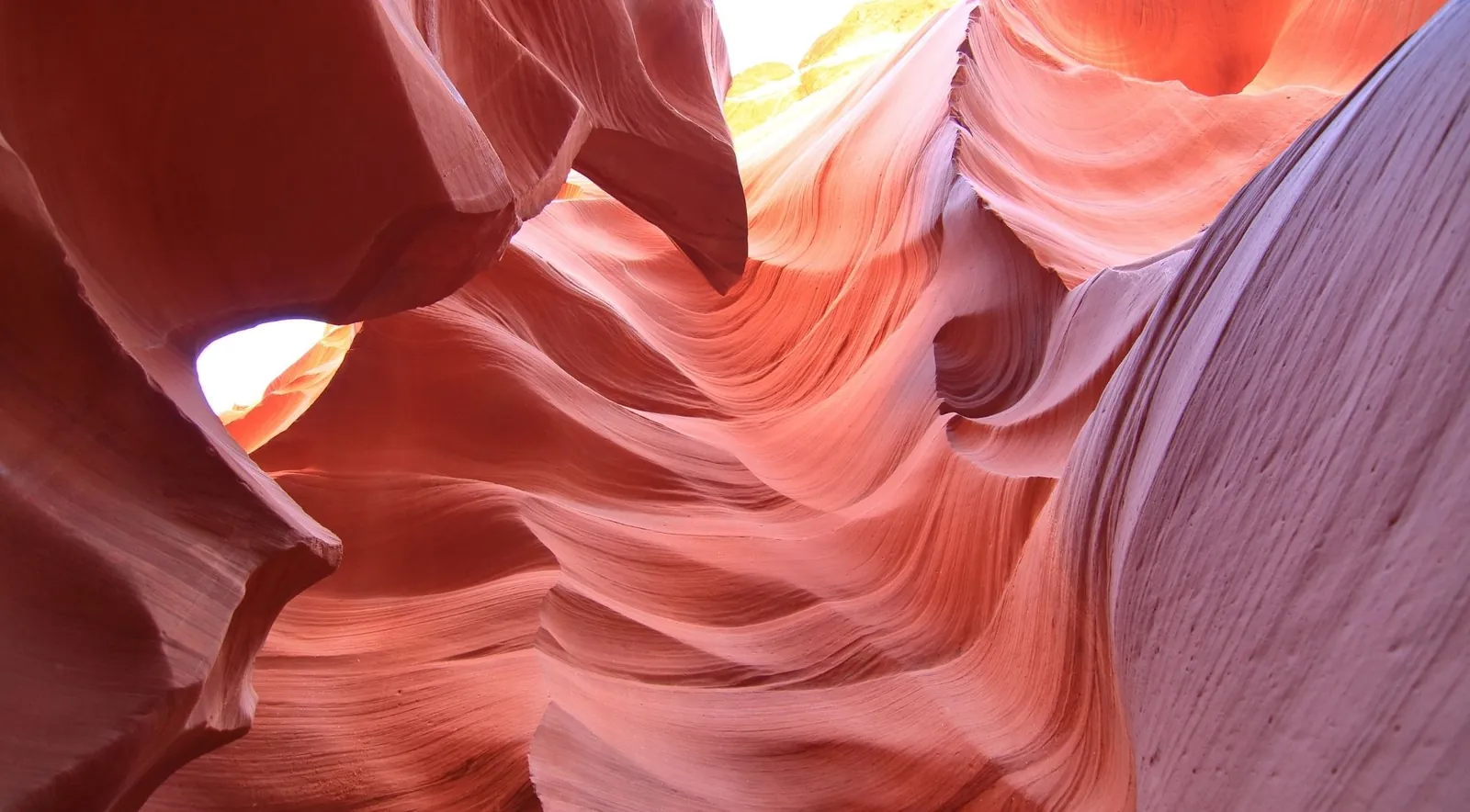
Midday light in Antelope Canyon, Navajo Nation near Page, Arizona · Photo: editorial
Live availability · Lower Antelope Canyon, Navajo-guided entry
Antelope Canyon is a slot: a crack in the sandstone a few metres wide and up to about 120 ft deep, with the sky as a ribbon overhead. Almost nothing else about it changes through the year. The rock is the rock, the walk is the same walk, and the group size is capped at 15 people per guide in January as in July. What moves is the sun.
At the canyon's latitude the midday sun climbs to 77° around the June solstice and sinks to 30° around the December one. In June it is nearly overhead, so light drops most of the way down the walls and reaches the floor. In December it comes in at a shallow angle, lights the top of the slot and leaves the bottom in reflected glow. That is the whole mechanism behind every other recommendation on this page.
The second half of it is the clock. Solar noon at Page is neither 12:00 nor the same time all year: it drifts from about 12:10 p.m. in mid-October to about 12:40 p.m. in mid-February, because the earth's orbit is not a circle. A tour sold as the noon departure puts you in the canyon half an hour off the peak in some months and right on it in others, which is why the date planner below gives you the actual time for your date, not a rule of thumb.
What the angle means on the ground
Above about 65° (roughly late April to late August): the strongest beam conditions in Upper Antelope, and the most saturated colour in both canyons.
48° to 65° (roughly late March to late April, and September to early October): beams form but are thinner and shorter-lived; colour is still very good.
Below 48° (roughly mid-October to mid-March): no vertical beams. The canyons are lit by light bouncing between the walls, which is softer, and in Lower Antelope genuinely beautiful.
Other experiences you might enjoy
Live availability from GetYourGuide — more Navajo-guided canyon tours, Horseshoe Bend trips and Page-area day trips, picked automatically for this page.
The two canyons want opposite hours
This is the part that catches people out, and the most useful thing to know before you book a slot.
Upper Antelope is a midday canyon. It is narrow at the top and wide at the bottom, so direct light only reaches the floor when the sun is close to overhead. Antelope Canyon Navajo Tours puts the window plainly: "The sun is at its peak between 11 am and 1:30 pm, so this is the time range to aim for if you want to see the lights." Outside those hours Upper is dark, and the beams are simply not there.
Lower Antelope is not. Its walls open upward instead of inward, so it is lit by light bouncing off the sandstone, not by a shaft coming straight down. Angled light brings out the widest range of colour, and its operator says so directly: "During the months of March to October, the best time to view the canyon will be in the morning from 7:15 am to 10:45 am or the later afternoon, after 1:45 pm."
So the midday slot that is the whole point at Upper is the one Lower's own operator steers you away from. Midday at Lower is not a bad visit, and the busiest and often priciest hour of the day, because it is where everyone who could not get an Upper beam slot ends up. If Lower Antelope is your canyon and you have any choice of time, take the early slot or the later one.
On the winter timetable those windows shrink with everything else: the day runs 8:45 a.m. to 2:45 p.m., so the practical picks are the first departure and the last. The operator publishes the two timetables without naming the date it switches between them, so if your trip falls in spring or autumn, check the departure list for your own date before you plan around an early or late slot. For the full side-by-side on which canyon to choose, see our Upper vs Lower Antelope Canyon comparison.
Check your own date
This works out what the sun will actually be doing on your date, and what that means for each canyon separately. They are grounded by different things, so the same day is often good for one and ordinary for the other.
Showing the sun angle computed for the canyon. Within about 16 days of today the card adds the cloud forecast for the hours tours run, and says so when it does.
Midday sun48–77°
Sun highest at12:10–12:40 p.m.
Upper Antelope Canyon
Beams need the midday sun above roughly 48°, which here means late March to early October
Aim to be inside between 11:00 a.m. and 1:30 p.m.
Heavy cloud removes the beams inside the season, and is not refunded
Lower Antelope Canyon
Operator's own pick: 7:15–10:45 a.m. or after 1:45 p.m., March to October
Lit by reflection, so a grey day costs it far less than it costs Upper
Stairs and ladders on the way in, so grip matters more than heat
Pick a date above and this line says which canyon it suits, and why. Without a date it is the general case: beams from late March to early October in Upper, and Lower at its best at the ends of the day.
The sun angle is astronomy and holds for any year. The cloud forecast is a forecast. Neither can tell you whether a given departure still has seats, which is what the availability calendar above is for.
Lower Antelope Canyon Entry and Navajo Guided Tour
★★★★★4.7(more than 9,500 reviews)·1 hour·From $75Permit included
A licensed Navajo guide takes you down the ladders and through the slot. It is bookable across the whole day, not only at midday, which is what makes it the right ticket if you want Lower Antelope at the hours its own operator recommends.
Roughly one hour inside the canyon with a local Navajo guide
Navajo Nation permit and booking fees included
Free cancellation up to 2 days before · mobile voucher
Coming for the beams instead? They are in Upper Antelope, and Upper Antelope midday tours are a different booking.
The light beams, in detail
The vertical shafts of light that put Antelope Canyon on every desktop wallpaper form in Upper Antelope Canyon only. Lower Antelope does get light shafts in summer, but they are occasional and far less defined. Antelope Canyon Time Services is blunt about it: "Most beams can be seen in Upper Antelope Canyon. They occur in Lower Antelope Canyon as well, but light beams are few and far between."
WhereUpper Antelope only
SeasonLate March–early October
StrongestJune · July · August
Daily window~11 a.m.–1:30 p.m.
The season. Operators publish it as starting around 20 March and running into early October. That lines up with the geometry: 20 March 2026 is the equinox, when the midday sun here reaches 53°, and the sun stays above 48° until the first week of October. Note that the sun's year is symmetrical about the June solstice while the published season is not, so the autumn edge runs a week or two past the angle that starts it in spring. If you are choosing between the two ends, the spring end is the more reliable one for the same sun angle.
The strength. June, July and August are when operators say the beams are at their best, and those are the months the midday sun sits between 67° and 77°. June is the pick of the three, because it has the highest sun of the year and the least rain: 0.12 in at Page, with measurable rain on 0.3 days in an average month, against 1.7 days in July and 1.9 in August.
What cancels them. A beam is a shaft of direct sunlight, so cloud removes it. One operator warns that "a day with rain or heavy cloud cover could limit, or even prohibit, the viewing of these beams," and another states plainly that it will not refund a beam-less cloudy day, because "we do not control the weather." This is the part to plan around: you can book the slot and the season, but not the sky. If beams are the reason for the trip, give yourself two possible days instead of one, and check the forecast two or three days out.
Tripod tours at Upper Antelope ended by Navajo Nation order in 2019, so every standard tour is now handheld-only and large bags are banned in both canyons. Our photography guide has the current rules and what they mean for your camera.
Month by month
The sun angle is computed for the canyon itself. The temperature and rainfall are thirty-year averages for Page Municipal Airport, about 7 miles away and 4,288 ft up, so they describe the town and the drive, not the shaded air inside the slot. The last column is a visitor index for the Page area, explained under the table.
Antelope Canyon by month: sun computed for the canyon, weather from Page Municipal Airport (NOAA), visitor index for the Page area from Glen Canyon National Recreation Area (NPS)
Month
Midday sun
Beams (Upper)
High at Page
Rain at Page
Page-area visitor index
January
32°
None
46.2°F
0.57 in
30
February
41°
None
53.0°F
0.56 in
53
March
51°
From about the 20th
63.3°F
0.48 in
107
April
63°
Yes, strengthening
71.5°F
0.36 in
130
May
72°
Yes, strong
81.8°F
0.41 in
139
June
76°
Strongest
93.6°F
0.12 in
170
July
75°
Strongest
98.0°F
0.55 in
155
August
67°
Strong, fading
94.7°F
0.75 in
128
September
56°
Yes, thinning
86.7°F
0.67 in
109
October
44°
To about the 5th
72.1°F
0.82 in
89
November
35°
None
56.6°F
0.41 in
54
December
30°
None
45.2°F
0.43 in
36
The visitor index sets an average month at 100, so June at 170 is about seventy per cent above average and January at 30 is under a third of it. It is built from recreation visits to Glen Canyon National Recreation Area, the NPS unit that wraps around Page and Lake Powell. It is a good indicator of how busy the town, the roads and the hotels are, and it is not a count of people inside the slot canyons, which sit on Navajo Nation land and are not publicly counted. Much of that summer peak is Lake Powell boating, not canyon tours.
Two things in the table surprise people. October is the wettest month at Page, at 0.82 in, just ahead of August, so the quiet autumn is not automatically the dry one. And June is the driest by a wide margin, at 0.12 in, which is why it is the most reliable month for beams even though it sits inside the official monsoon season.
Monsoon and flash floods
The National Weather Service monsoon season runs from 15 June to 30 September. For northern Arizona, NWS Flagstaff adds the detail that matters for planning: moisture "typically does not reach the region until the first week of July," and when it does, rainfall "is not continuous, but comes most days in the form of afternoon and evening thunderstorms."
That is why the advice to book a morning slot in July, August and September is not a preference. Storms build after midday, so an early departure is usually finished before the risk peaks, and it also puts you in the canyon before a cancellation decision has to be made.
Why a slot canyon takes this seriously
Antelope Canyon drains a wash. A thunderstorm well upstream can send water through the slot under a clear sky overhead, and there is nowhere to climb to. On 12 August 1997 a group of 12 hikers was caught in Lower Antelope Canyon; 11 died and only their guide survived. The National Climatic Data Center record reads: "A severe thunderstorm 3 to 5 miles upstream produced very heavy rain causing a 10-30 foot wall of water to crash down Antelope Canyon."
Modern operators run strict protocols because of it. They watch National Weather Service flash-flood watches and Navajo Nation Parks closures, and they will cancel, sometimes at short notice and sometimes mid-morning, when conditions turn. Weather cancellations are normally refunded or rescheduled, which is the opposite of the cloudy-day rule for beams. Do not argue with one.
Outside the monsoon window cancellations are much rarer, though they do not disappear. Winter tours are seldom called off, but snow occasionally closes highways around Page and makes the approach slower than the canyon.
Crowds, prices and hours
Group size is capped all year. Per the Lower Antelope operator's own FAQ, "Each of our tour times for the Lower Antelope Canyon has a maximum capacity of 70 guests; however, you are split into groups of 15 or fewer per tour guide." So the season changes the queue outside, the price and how far ahead you must book, more than it changes how many people are walking beside you.
Around Page the swing is large. Visits run about seventy per cent above an average month in June and around a third of one in January, which is what you feel in the car parks, the restaurants and the hotel rates rather than inside the slot. Weekdays are easier than weekends in every month, and the first and last departures are the thinnest.
Hours shift with the season
Both canyons are open every day of the year except Thanksgiving Day and Christmas Day, and tours run on Arizona time (MST) year-round, which is worth double-checking if you are driving in from Utah. The Lower Antelope timetable is published as 6:15 a.m. to 4:45 p.m. in summer and 8:45 a.m. to 2:45 p.m. in winter: both ends move, and the winter day is about four and a half hours shorter. Upper operators space departures further apart, roughly 90 minutes to two hours. Arrive 45 minutes before your slot time, which the operators ask for and which is the part of a summer visit spent standing in full sun.
Prices. The two Lower Antelope operators, Ken's Tours and Dixie Ellis', are broadly flat across the year at about $80.50 per adult booked direct, and the Navajo Nation permit is $15 per person, per location, per day, an increase on the previous $8. Upper operators charge a premium for the midday beam slots, which is the one place the season really moves the price. On GetYourGuide the Lower entry tour starts at $75 including the permit. Winter is the cheapest time overall, mostly through hotel rates in Page, not through the tour itself. For the current numbers and cancellation rules, see our tickets & booking guide.
How far ahead to book. Midday slots between April and September go first, often weeks or months out, and it is the factor most likely to get in the way, whatever the light is doing. Shoulder months want a few weeks. In December and January you can often book days ahead, with the exception of Thanksgiving week, Christmas and spring break.
Pick by what you came for
There is no month that serves all three of these at once, which is why the recommendation splits three ways.
The beams
June, midday, Upper Antelope
Highest sun of the year at 77° and the driest month at Page. Book the slot that puts you inside close to solar noon, accept the year's biggest crowds around Page and a 93.6°F average high, and keep a spare day in case the sky does not cooperate.
The sun is 63° in mid-April and 53° on 22 September, both inside the season operators publish, so beams are on the table without June's heat or its booking pressure. April is also drier than September, at 0.36 in against 0.67 in.
Visits to the Page area fall to about a third of an average month, hotel rates follow, and tours keep running on the 8:45 a.m. to 2:45 p.m. timetable. There are no beams: the midday sun only reaches 30°. What you get instead is a quiet canyon and soft reflected colour.
Families. Upper is flat sand and easier with small children, though soft sand defeats a stroller. Lower needs steep metal stairways and ladders, and operators commonly set a minimum age. Morning slots are cooler and calmer for children in either canyon.
If your dates are already fixed, the hour is the part you still control. Use the date planner, take the slot it points at, and book it for the first or second day of your trip rather than the last, so a weather cancellation still leaves you somewhere to move it to.
How we know, and where the evidence stops
Sun angles and solar noon are computed for Upper Antelope Canyon, 36.8619° N, 111.3743° W, on Arizona time (MST), using standard low-precision solar position formulae. This is astronomy, not a sample: it holds for any year, and the figures in the month table are for the 15th of each month.
Temperature and rainfall are NOAA/NCEI 1991–2020 monthly normals for Page Municipal Airport, station USW00003162, at 4,288 ft. The airport is about 7 miles from the canyon.
The visitor index is built from National Park Service monthly recreation visits to Glen Canyon National Recreation Area, averaged over 2023, 2024 and 2025, indexed so an average month is 100.
Monsoon dates and behaviour come from the National Weather Service, including NWS Flagstaff's northern Arizona monsoon page.
Beam season, tour hours, group caps and the permit fee come from the operators' own published pages and from Navajo Nation Parks & Recreation, checked on 12 September 2026.
Tour prices, ratings and review counts come from the GetYourGuide activity pages for all 24 tours this site links, re-checked on 12 September 2026 and stored with the page.
What these numbers cannot tell you
The visitor index is a proxy. It counts people entering a national recreation area that is dominated by Lake Powell boating, and it does not measure how many people are booked into a slot canyon tour. Nobody publishes that: the canyons are on Navajo Nation land and the counts are not public. Treat the column as how busy Page is, not how busy your tour is.
Climate normals are averages over thirty years, not a forecast, and an average high does not prevent a hotter day. The canyon interior is also cooler and shaded for most of the walk, so the airport figure describes the wait and the drive better than the tour.
The beam season is operator consensus with a computable mechanism behind it, not a guaranteed date range. Where operators and geometry disagree — chiefly at the October end — we have said so rather than picked the flattering version.
We do not have a live per-date availability feed. GetYourGuide blocks automated requests from our tooling, so the planner never claims a slot is bookable; the availability calendar on this page is the thing that knows.
The operator publishes a summer and a winter timetable but not the dates it moves between them, so we have not put a changeover date on the page. In March, April, October and November, check the departure times for your own date.
Prices change between checks, and ours were taken on 12 September 2026. The permit is set by the Navajo Nation and has moved before. Confirm both at checkout.
Frequently asked questions
What is the best time of year to visit Antelope Canyon?
It depends what you have come for, which is why there is no single answer. For the best overall balance, April or the second half of September: the midday sun is still high enough for the beams in Upper Antelope, without June's heat or its booking pressure. For the best odds on the beams themselves, June, which has both the highest midday sun of the year at 77 degrees and the least rain of any month at Page. For a quieter and cheaper trip, December or January, when there are no beams at all and the tours run on a six-hour winter timetable.
When can you see the light beams in Antelope Canyon?
The vertical light beams form in Upper Antelope Canyon, not Lower, and only when the sun is close to overhead. Operators publish the season as starting around 20 March and running to early October, which brackets the period when the midday sun at the canyon is above roughly 48 degrees. They are strongest in June, July and August, when it reaches 67 to 77 degrees. They also need direct sun on the day: heavy cloud removes them inside the season, and operators do not refund for weather.
What is the best time of day to visit Antelope Canyon?
The two canyons want opposite hours. Upper Antelope is narrow at the top and wide at the bottom, so it needs the sun almost overhead: aim to be inside close to solar noon, which at Page falls between 12:10 p.m. and 12:40 p.m. depending on the date, not at a fixed clock time. Lower Antelope is lit by light bouncing off its walls, not by direct shafts, and its own operator recommends 7:15 a.m. to 10:45 a.m. or after 1:45 p.m. from March to October.
Is summer a good time to visit Antelope Canyon?
June is the strongest month for the beams and the driest month at Page, with 0.12 in of rain. July and August keep a high sun but bring the monsoon: the National Weather Service season runs 15 June to 30 September, and NWS Flagstaff notes the moisture usually arrives in the first week of July as afternoon and evening thunderstorms. A slot canyon is a drainage, so operators cancel when storms threaten. Book a morning slot in those months and leave a spare day. Page also averages 98 degrees Fahrenheit in July, and the 45-minute wait before your tour is in full sun.
Which months are quieter at Antelope Canyon?
Visits to the Page area drop to about a third of an average month in December and January, so that is when the roads, the car parks and the hotels are easiest. Tours keep running through those months on a shorter timetable, and there are no light beams, because the midday sun only reaches about 30 degrees. Inside the canyon the difference is smaller than you might expect in any month: group size is capped at 15 guests per guide all year. Early-morning and late-afternoon slots and weekdays are quieter in every season.
Upper for the beams and the midday sun, Lower for reflected colour at the ends of the day, winter for a canyon nearly to yourself. See live availability on GetYourGuide, and a licensed Navajo guide takes it from there.
This site contains affiliate links. We may earn a commission when you book through our links — at no extra cost to you. Antelope Canyon tours are operated exclusively by Navajo family–owned businesses on Navajo Nation land.