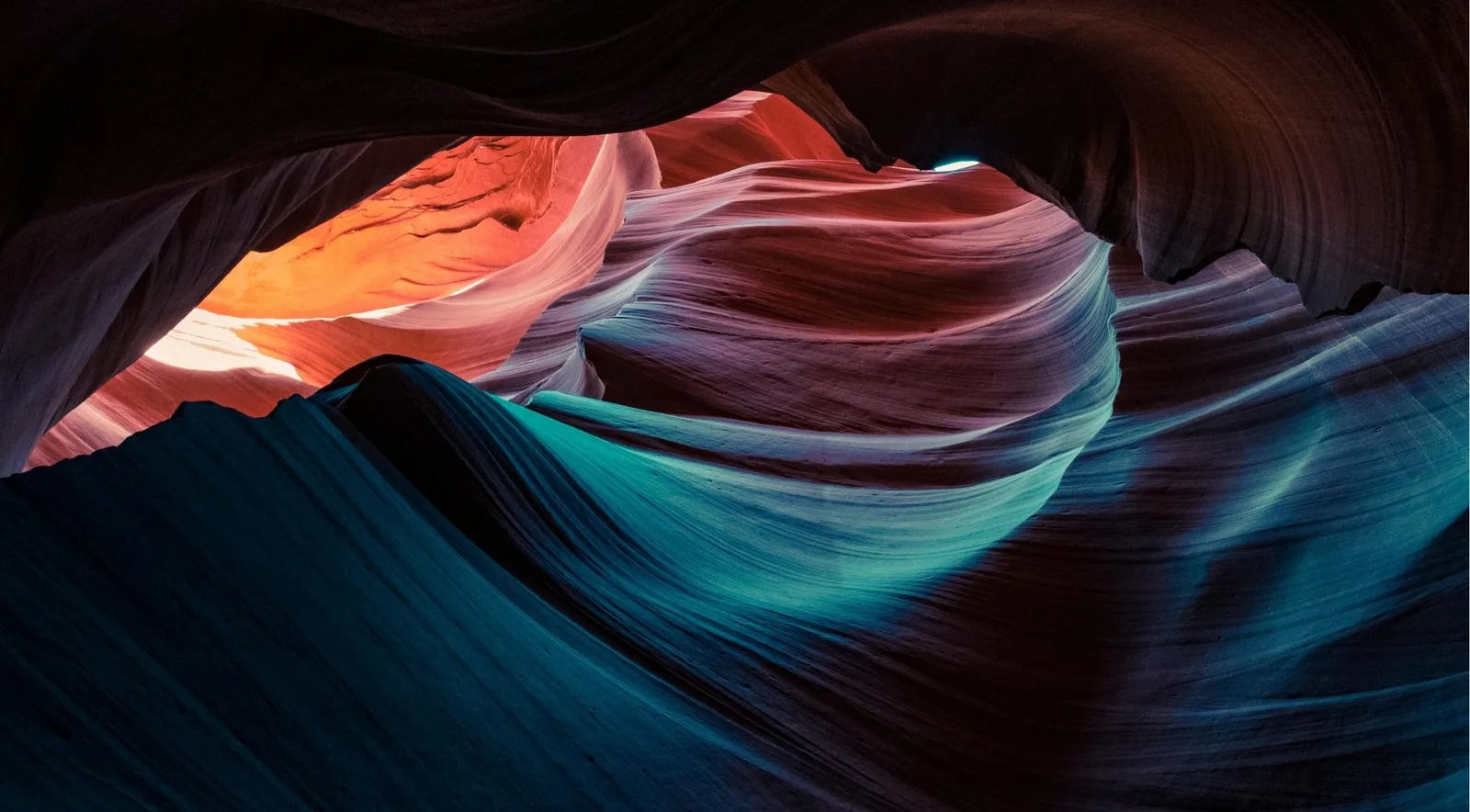
Antelope Canyon Photography: Best Shots, Camera Tips & Current Rules
Tripods have been banned at Upper and Lower Antelope Canyon since 2019, and the dedicated photo tours that once allowed them are gone. That doesn't mean the great shot is gone too — here's which canyon shoots easiest handheld, the settings that actually work in the low light, and the timing that gets the best colour.
In December 2019 the Navajo Nation Parks and Recreation Department, working with operators, ended dedicated photographer-only tours at Upper Antelope Canyon — the change took effect December 20, 2019. Roger Ekis's Antelope Canyon Tours states it plainly: "2019 was the last of the photographic tours to Upper Antelope Canyon," and commercial-use photography and productions "are simply not allowed right now." Lower Antelope's two operators, Ken's Tours and Dixie Ellis, phased theirs out over roughly the same period — Earth Trekkers notes the change "began in 2018." The slower pace of tripod-equipped groups was causing bottlenecks for everyone else in line. Today, every Upper and Lower Antelope tour is a standard, handheld-only sightseeing tour — mixed-skill groups, fast pace.
Tripods / monopodsBanned everywhere
Handheld DSLR / phoneAllowed, on a strap
GoPros / videoBanned at Lower
DronesBanned Nation-wide
Tripods, monopods, selfie sticks and stabilisers: banned at Upper, Lower and every public Antelope Canyon section since 2019, confirmed across operator sites and Navajo Nation guidance.
Cameras allowed: DSLRs and mirrorless cameras are allowed on standard tours, carried on a neck or hand strap. Lower Antelope operators limit guests to one camera — the official allowed-items list permits a camera, cell phone and water bottle. The "no professional equipment" rule targets tripods and supports, not the camera body.
Bags at Lower: Dixie Ellis's official FAQ states "bags are not allowed… This includes transparent and clear bags. This rule is effective May 4th, 2023" (medical bags exempted; a water bottle with a strap is fine). Operator pages conflict slightly — one Ken's-affiliated booking page still lists a single clear bag as allowed — so confirm with your specific operator.
Bags at Upper: backpacks, large bags, purses and camera bags are prohibited. Roger Ekis's FAQ allows only "clear (transparent) bags" and adds, "We do not allow opaque bags to be placed inside a clear bag." The new one-way traffic system has led some operators — Ekis among them — to permit one small backpack per couple or family.
GoPros, action cameras and video: Ken's Tours' terms state "filming is not allowed inside Lower Antelope Canyon," and that "GoPros… recorded eyewear (e.g. Meta sunglasses), and GoPros are not permitted on any Lower Antelope Canyon tour," along with gyro-stabilizers, selfie sticks, hiking sticks and canes. Flash is prohibited too.
Drones: the official permit page states "Drones are Prohibited at all Navajo Tribal Park locations" — that is the entire Navajo Nation, not just the canyon.
Commercial or styled shoots: require a valid Special Use or Film/Photography permit from Navajo Nation Parks & Recreation (the Lake Powell Tribal Parks & Recreation Office) and/or the Navajo Office of Broadcasting Services Film Office. Standard tour photos for personal use are fine.
The one exception: Antelope Canyon X
Taadidiin Tours, the sole operator of Antelope Canyon X, still runs a dedicated photo tour that explicitly permits a tripod. Its official site lists the photo tour at $142 per person plus a $15 hiking permit (ages 8+), duration 3 hours, with "Tripod and 1 camera bag" named under "What to Bring." The standard Antelope Canyon X Hiking Tour is $44.34 for adults (18+) and $34.91 for children 8–17, plus an $8 hiking permit for ages 8+. Smaller groups, more time per stop, no reliable light beams, but a genuine hybrid of Upper and Lower's formations.
One caution on sourcing: an independent guide claimed in May 2026 that "no operator is running tripod-permitted tours" — contradicted by Taadidiin's own current site and 2026 reseller listings, which name a tripod as a "what to bring" item. Trust the operator's primary source, and confirm by phone if you are booking specifically to use a tripod.
Other experiences you might enjoy
Live availability from GetYourGuide — more Navajo-guided canyon tours, prime-time entry slots, and trips that pair a canyon visit with Horseshoe Bend for a full day of shooting near Page, picked automatically for this page.
Which canyon is best for photography
Upper vs Lower Antelope Canyon vs Canyon X — for photographers
Upper Antelope
Lower Antelope
Canyon X
Light beams
Yes — the iconic shafts
Rare, no reliable beams
Some light play, no beams
Ease handheld
Harder — darker, more contrast
Easier — brighter, even glow
Easier — fewer crowds to work around
Tripod allowed?
No
No
Yes, on the dedicated photo tour
Crowds
Heaviest
Heavy, but faster-moving
Much smaller groups
Best for
The must-have beam shot
Easy, colourful handheld results
Relaxed shooting, tripod work
Honest take for the average phone or handheld shooter: Lower Antelope Canyon is the easier canyon to come home with great photos — more ambient light, more time inside, and a lower price than Upper. Choose Upper only if the light-beam shot is the priority and you can book a midday slot in season. A midday prime-time entry is the single best-timed slot for Lower Antelope's colour.
Timed for the brightest colour
Lower Antelope Canyon Prime Time Entry & Navajo Guide
★★★★★4.6(1,641 reviews)·1–1.5 hours·From $75Permit included
A licensed Navajo guide walks you through Lower Antelope at the midday window, when the sandstone reads its most saturated orange, copper and lavender — the easiest light of the day for handheld phone or camera shots. Guides routinely take phone photos for guests using the camera's filter modes, and can point out the angles that shoot best.
Lower Antelope Canyon entry at the midday prime-time window
~60-minute walking tour with a local Navajo guide
Navajo Nation permit and booking fees included
Free cancellation up to 2 days before · mobile voucher
Free cancellation up to 2 days before · instant confirmation
Timing the light beams (Upper only)
Light beams occur almost exclusively in Upper Antelope Canyon, a product of its A-shaped cross-section admitting direct overhead sun. Antelope Canyon Navajo Tours states that "the sun is at its peak between 11 am and 1:30 pm, so this is the time range to aim for if you want to see the lights."Season: late March to October, with "the best months for the beams… June, July, and August" — and beams require a sunny day. Because check-in queues run long in season, book a slot starting around 11 a.m.–noon so you're inside during the window. To photograph a beam: expose for the bright shaft rather than the dark walls, shoot quickly, and let your guide toss a handful of sand into the beam — it's the classic trick that makes the light visibly pop in-frame.
Lower Antelope occasionally gets a faint shaft around midday, but it's "few and far between" compared to Upper's dramatic vertical column — don't plan a Lower Antelope visit around chasing a beam shot. For the fuller seasonal breakdown, see our best time to visit guide.
Crowds and timing for cleaner frames: peak season is May–September and midday hours are busiest. Shoulder seasons (late March–mid-May and mid-September–October) balance light against crowds; winter is quietest but gives you no beams. Early-morning and late-afternoon tours, and weekdays, leave more room in the frame. To deal with people in shot: shoot upward, hang at the back of your group, work quickly, and consider Canyon X for genuinely empty stretches.
Camera settings & technique (handheld, no tripod)
Mode: Aperture Priority or Manual with auto-ISO; shutter-priority with a fixed minimum speed also works.
Shutter speed: at least 1/40s, ideally 1/60s or faster handheld to avoid blur; wider lenses tolerate slower speeds.
Aperture: dim conditions push you toward f/2.8–f/4 to gather light; some shooters prefer f/8–f/11 for depth of field but must raise ISO to compensate.
ISO: expect ISO 800–3200, sometimes higher — modern full-frame sensors handle ISO 3200–6400 cleanly. Use AI denoise in post.
Stabilisation: turn IBIS or lens stabilisation ON — it buys 4–6 stops of handheld leeway. Brace against a wall only where your guide permits.
White balance: don't trust auto — it neutralises the warm tones into grey-cyan. Set a manual daylight/cloudy white balance (~5500–6500K) or shoot RAW and correct later.
Dynamic range: shoot RAW. The contrast between the bright opening above and the dark walls is extreme — expose to protect highlights, then lift shadows afterward. On a tripod-permitted Canyon X tour you can bracket and merge HDR; handheld, use a single RAW and raise shadows, avoiding handheld HDR merges because they ghost. In editing, pull orange saturation back slightly so the sandstone doesn't go neon.
Composition: look up, follow the curving leading lines, and shoot above other visitors' heads to keep crowds out of frame.
Smartphone vs DSLR/mirrorless
A realistic expectation: a current flagship phone often beats an entry-level DSLR in this environment, because computational Night Mode and HDR handle the low light and extreme contrast automatically. Modern phones — iPhone 12 Pro and later, Pixel 6+, Galaxy S22+ — do superbly. Use the wide or ultra-wide lens, shoot vertical panoramas, let Night Mode trigger in dim sections, shoot RAW/ProRAW if your phone supports it, keep flash off, and tap to set focus and exposure.
If you do bring a dedicated camera, pack one wide-angle lens (roughly 16–35mm full-frame or 10–22mm APS-C) and don't change lenses inside — airborne sand is constant. Given the tripod ban and the fast pace of a standard tour, a phone plus at most one mirrorless body with a fast wide lens is the practical kit.
Practical shooting tips
Protect gear from sand
Falling sand is constant — guides sometimes tap the walls to cascade it for dramatic photos. Use a UV/clear filter as a sacrificial layer, keep the camera in a small dust bag between shots, and blow it out with compressed air once you're back outside.
One lens, no swaps
Wide angle is essential for the narrow passages and tall walls. Never change lenses inside the canyon — the airborne sand gets into everything.
Lean on your guide
Navajo guides are the single biggest asset for a good photo — they position you, set phone camera modes, know the angles and the light, and often shoot your best frame of the day themselves.
Move fast, decide fast
Standard tours are brisk — roughly 30–60 minutes inside, in groups of 10–15. Shoot as you walk and don't expect time to set up a composition.
The verdict — what to book for the shot you want
Set realistic expectations: the golden age of tripod-on-the-canyon-floor photo tours is over at Upper and Lower. But a standard guided tour plus a good phone or handheld camera produces excellent results.
Want the iconic beam shot: Upper Antelope Canyon, a midday slot around 11:00 a.m.–12:00 p.m., late March–early October, on a sunny day. Upper's walls rise over 100 feet and it produced most of the world's famous slot-canyon images — but it's darker, harder to expose handheld, very crowded and the most expensive.
Want easier, more colourful handheld shots at lower cost: Lower Antelope Canyon, late morning, with Ken's Tours or Dixie Ellis — around $80+ all-in.
Want a relaxed, uncrowded shoot, or still want a tripod: Antelope Canyon X with Taadidiin Tours — the standard hike at $44.34 adult plus an $8 permit, or the 3-hour photo tour at $142 plus a $15 permit.
Either way, book early. Both Upper and Lower require mandatory Navajo-guided tours and advance booking, and Upper midday slots can sell out months ahead. GetYourGuide aggregates all sections and includes the Navajo permit fee.
Thresholds that change the advice
If you can only go in winter or on a cloudy day, skip the beam-chasing premium at Upper and book Lower or Canyon X. If a tripod and unhurried composition are non-negotiable, Canyon X's photo tour is your only option. If Upper is sold out, Canyon X is the best substitute.
Where these rules come from — and what to re-check
Policies vary by operator and season and have changed repeatedly. Always confirm current rules directly with your operator before booking. Operator pages even conflict on the Lower bag rule — clear bags banned versus one clear bag allowed — so verify with yours. Confirm tripod policy with Taadidiin directly if you're booking Canyon X specifically to use one.
Prices are 2026 figures from operator and reseller sites and shift by season, time slot and pickup city. A Navajo permit fee — commonly $15 per person per location, sometimes still listed at $8 — and a guide tip are typically added on top.
Light beams are weather-dependent and never guaranteed, even in season.
Arizona uses MST year-round and does not observe daylight saving; the surrounding Navajo Nation and Utah may differ — verify your tour's time zone. Our getting there guide covers the trap in detail.
Sources are predominantly 2025 and 2026. The core photo-tour and tripod ban, and the Canyon X exception, are confirmed for 2026 via primary operator and Navajo Nation sources, while some technique and crowd details draw on 2024 and 2025 reporting.
Frequently asked questions
Can you bring a tripod to Antelope Canyon?
No, not at Upper or Lower Antelope Canyon — tripods, monopods and selfie sticks have been banned at both since 2019. The one exception is Antelope Canyon X, run by Taadidiin Tours, which still offers a dedicated photo tour that explicitly permits a tripod. That tour isn't part of this site's Lower Antelope Canyon tour inventory, so confirm current tripod policy directly with Taadidiin before booking if a tripod is essential to your shoot.
Do I need a DSLR to get good photos in Antelope Canyon?
No. A current flagship smartphone (iPhone 12 Pro or newer, Pixel 6+, Galaxy S22+) often outperforms an entry-level DSLR here, because computational Night Mode and HDR handle the canyon's low light and extreme highlight-to-shadow contrast automatically. If you do bring a dedicated camera, one wide-angle lens is all you need — there's no time or space to change lenses inside, and airborne sand makes it risky anyway.
Are dedicated photography tours still offered at Antelope Canyon?
Not at Upper or Lower. The Navajo Nation and both operators discontinued tripod-permitting photo tours around 2018–2019 because the slower, equipment-heavy groups caused bottlenecks for other visitors. Every Upper and Lower Antelope tour today is a standard, handheld-only sightseeing tour. Antelope Canyon X is the exception — it still runs a 3-hour tripod-permitting photo tour through a separate operator. See our Lower Antelope tours guide for how Ken's Tours and Dixie Ellis' compare.
What is the best time of day for Antelope Canyon photos?
For Upper Antelope's light beams, aim for an 11 a.m.–1 p.m. slot, late March through early October, on a sunny day. For Lower Antelope, which doesn't produce beams but glows more evenly, a midday "prime-time" slot gives the brightest, most saturated colour for handheld shots; late morning and early afternoon are the easiest windows for both light and thinner crowds.
Which is better for photography, Upper or Lower Antelope Canyon?
Upper Antelope is the only place to capture the iconic vertical light beams, but it's darker and harder to expose handheld. Lower Antelope is brighter, more colour-saturated, and easier for the average phone or handheld shooter to come home with great images, since its V-shape lets in more ambient light throughout the day. For most travellers without a tripod, Lower Antelope is the easier canyon for consistently good photos.
See live availability on GetYourGuide for the Lower Antelope prime-time entry, and a licensed Navajo guide handles the rest — including pointing out the angles that shoot best.
From $75 per adult, permit included
Midday prime-time slots for the most saturated colour
This site contains affiliate links. We may earn a commission when you book through our links — at no extra cost to you. Antelope Canyon tours are operated exclusively by Navajo family–owned businesses on Navajo Nation land.