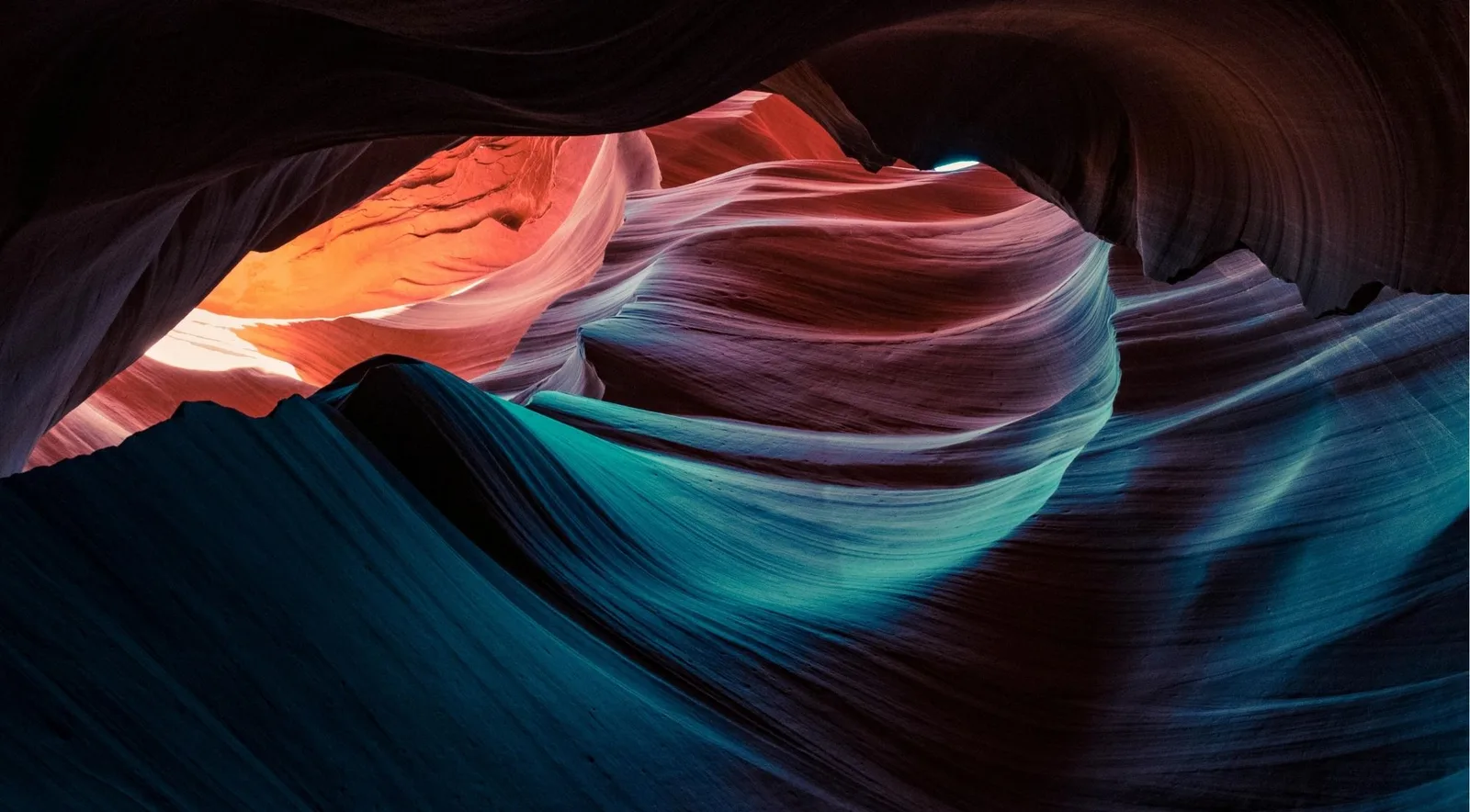
Best Time to Visit Lower Antelope Canyon in November and Winter for Photos
In winter, good Lower Antelope Canyon photos don't come from chasing the famous light beams. They come from knowing when the low desert sun lights up the sandstone walls.
Tours keep running from November to February on a shorter day, and the canyon still glows pink, orange, copper and purple. Here is which departure to pick, month by month, and how to set up your phone or camera.
Reflected light on the walls of Lower Antelope Canyon, Navajo Nation near Page, Arizona · Photo: editorial
Live availability · Lower Antelope Canyon, late-morning and midday departures
The light depends on the date, cloud cover, the shape of each passage and the pace of your tour. These are recommendations, not guarantees.
Winter flips one piece of the usual advice. From March to October, Lower Antelope's operator steers visitors towards the morning or the later afternoon and away from midday, as our year-round best-time guide explains. From November to February the sun stays low all day, so late morning and midday become the brightest part of a short winter timetable.
Why is the light different in winter?
Lower Antelope Canyon's walls curl overhead in soft, flowing shapes. The colours change with the light because sunlight comes in through the openings and reflects from one sandstone surface to the next.
In summer the high sun lights many of the openings more directly. In winter it takes a lower path across the sky, and the deepest parts of the canyon get less light. The result is more subdued colour and stronger shadows.
You might see warm copper-orange on a brightly lit surface, soft pink or peach along a wall lit by reflection, and darker red or violet patches in deep shade. Your camera's white balance affects how purple a section looks in photos. One passage can be bright and the next dim, because the canyon changes direction constantly.
Will I see the famous light beams?
Don't expect the classic vertical beams in winter. The columns of sunlight in famous Antelope Canyon photographs belong mainly to Upper Antelope Canyon in the high-sun months. Lower is better known for its intricate curves and reflected light even in summer, and from November to February the low sun makes beams especially unlikely.
That is no reason to skip the canyon. In winter the shapes, the contrasting rock textures and the subtle reflected colour become the main event.
Other experiences you might enjoy
If you are in Page for the winter light, the area has more to photograph. These live GetYourGuide listings include Lower Antelope Canyon and Upper Antelope Canyon tours, Antelope Canyon X, the Horseshoe Bend overlook and Lake Powell boat and kayak trips around Page, Arizona.
Morning vs midday vs afternoon
No hour is perfect for every passage, but the seasonal pattern is still useful when you book.
Winter departure windows compared
Window
Likely conditions
Advantages
Drawbacks
8:45–10 a.m.
Soft light, darker passages
Atmospheric images, possibly fewer people
Cold, less light for handheld shots
10–11:30 a.m.
Light increasing
Good balance of colour and comfort
Often popular
11:30 a.m.–1 p.m.
Highest sun of the day
Strong potential for reflected light
Departures can be busy
1–2 p.m.
Shifting shadows
Contrasting textures, flexible timing
Light can fade inside
2–2:45 p.m.
Low afternoon sun
Dramatic shaded compositions
Especially dim in deep sections
Planning estimates, not a minute-by-minute forecast or a promise that every listed departure is offered.
8:45–10 a.m.: for atmospheric scenes
Early winter tours suit visitors who like subdued light, shadow and texture, and you'll usually finish in time to enjoy the rest of Page. Some passages can be quite dim, though, which means slower shutter speeds or a higher ISO, and winter mornings can be very cold. Go early if you would rather start your day than get the brightest possible images.
10–11:30 a.m.: a strong all-round choice
By late morning the sun is higher and more light reflects into the canyon. That helps handheld cameras use faster shutter speeds, and the sandstone shows a mix of lit surfaces and shadow. It is an excellent window for first-time visitors and smartphones.
11:30 a.m.–1 p.m.: for the most available light
If your biggest worry is a canyon that is too dark, midday is the one to book. The sun is at its highest point of the day, although in winter that is still far lower than in summer. Some passages get more reflected light, but this is also a popular departure window, and it won't light the whole route at once. On GetYourGuide, the Lower Antelope Canyon Prime Time Entry & Navajo Guide sells these late-morning and midday slots (from $75, 4.6/5 from 1,743 reviews).
1–2:45 p.m.: for shadows and flexible schedules
Afternoon light changes the balance between glowing sandstone and shaded background. Some compositions become dramatic while the deep passages get darker. A modern phone or stabilised camera can still take excellent shots, but watch for motion blur and over-processed Night Mode images.
When is solar noon in Page?
Solar noon is the moment the sun reaches its highest point, which isn't necessarily 12:00 p.m. on the clock. In November 2026 it falls between about 12:09 and 12:14 p.m. in Page.
Solar noon and the sun's highest angle at Page
Date
Approximate solar noon
Maximum sun altitude
November 1, 2026
12:09 p.m.
38.5°
November 15, 2026
12:10 p.m.
34.5°
November 30, 2026
12:14 p.m.
31.4°
December 15, 2026
12:21 p.m.
29.8°
Even at solar noon the winter sun is nowhere near overhead. Your departure time also isn't the time you reach any one photo spot: you check in, meet the guide and walk a managed route, and each part of the canyon catches the light differently. A good broad window matters more than hunting for a perfect minute.
★★★★★4.6(1,743 reviews)·1–1.5 hours·From $75Permit included
The late-morning and midday departures this page recommends, checking in at Ken's Tours. The walk covers about 1.1 miles, down five flights of stairs into the largest chamber and back up eight separate staircases, so allow 1.5 hours including the 30-minute check-in.
About 60 minutes in the canyon with a local Navajo guide
November has slightly longer days and usually milder temperatures than midwinter. Late morning is a good practical choice for reflected light and comfortable sightseeing, and around 10:30–11:30 a.m. is our pick if it's available. Our November guide covers weather, Thanksgiving dates and prices for the month.
December: approximately 10:30 a.m.–1 p.m.
December has the shortest days and the lowest sun, around the solstice. Some deep passages are dark, so late morning or midday is especially appealing if you are shooting on a phone. Try an 11 a.m. or noon departure if one is offered.
January: approximately 10:30 a.m.–1 p.m.
Cold mornings, short days and low-angle sunlight carry on into January. Outside New Year's and busy weekends, the month can be quieter. Late morning gives a good balance of light and temperature.
February: approximately 10 a.m.–1:30 p.m.
As the days lengthen and the sun climbs higher, both late-morning and early-afternoon tours work well. Late February generally has more daylight than December, although that doesn't guarantee brighter conditions in every passage. If you're still choosing your dates, our guide to which winter month is best compares weather, daylight and crowds.
Winter photo windows by month
Month
Preferred window
Strength
Main consideration
November
10 a.m.–1 p.m.
Milder weather
No summer light beams
December
10:30 a.m.–1 p.m.
Soft winter colour
Cold, short days
January
10:30 a.m.–1 p.m.
Can be quieter
Coldest mornings
February
10 a.m.–1:30 p.m.
More daylight
Weather still variable
What if it's cloudy?
Cloud doesn't necessarily ruin your photos. Bright overcast softens the contrast and brings out the sandstone textures, while heavy cloud can make the deep passages hard to photograph without blur or noise. On clear days, reflected sunlight gives stronger contrast and brightly lit curves.
Cloud is not the same as unsafe weather
Rain and storms bring a risk of flash flooding, including from rain that falls upstream of the canyon, and operators can delay or cancel tours because of it. Always follow the operator's safety decisions.
Smartphone settings for Lower Antelope Canyon
You don't need an expensive camera. A recent iPhone or Android phone can capture the sandstone beautifully if you use it carefully.
Start with the main 1× lens. It often does better than the ultrawide in low light, although phones differ.
Use the ultrawide selectively. It helps fit overhead openings into the frame but can add noise or distortion.
Turn on HDR or automatic dynamic range. The canyon has bright highlights and deep shadows.
Turn the flash off. It flattens the natural light and can disturb other visitors.
Tap to focus and adjust the exposure. Bring it down slightly if the bright sandstone looks washed out.
Use Night Mode with care. Longer exposures blur if you or other visitors are moving.
Avoid heavy digital zoom. Take a sharp original and crop it later.
Hold the phone securely. Don't take photos while you are climbing the steep metal stairs.
Smartphone starting settings
Setting
Starting recommendation
Main camera
1×
Ultrawide
For tight overhead compositions
HDR
Automatic / on
Flash
Off
Exposure
Reduce slightly if highlights clip
Night Mode
Use carefully in dark passages
Zoom
Avoid heavy digital zoom
Format
JPEG/HEIF; RAW if you edit confidently
Ask your Navajo guide for tips on angles and phone settings, and keep up with the group's pace.
DSLR and mirrorless settings for permitted handheld cameras
Camera rules are strict. Tripods, monopods and some professional equipment are not allowed on standard tours, so contact your operator before bringing a large kit. For a normal handheld camera that is allowed, these are sensible starting points:
Handheld camera starting settings
Setting
Starting point
Capture format
RAW if you like
Mode
Aperture priority or manual
Aperture
f/2.8–f/5.6 in darker sections
Shutter speed
Around 1/60–1/125 sec or faster handheld, if possible
ISO
Auto, perhaps 400–1600 depending on the light
White balance
Auto or a consistent custom setting
Flash
Off
Stabilisation
Use camera or lens stabilisation
None of these is a fixed recipe. Faster shutter speeds reduce blur, and a lower ISO only reduces grain if there is still enough light. Put sharp images first. A flexible wide-angle lens helps, and avoid changing lenses in blowing sandstone dust. Our Antelope Canyon photography guide covers the current camera rules in full.
Seven mistakes photographers should avoid
Expecting winter sunbeams. You are there for reflected light and rock forms.
Treating sunrise landscape advice as canyon advice. Early winter tours can be dim, not golden.
Exposing for the bright strip of sky. The sandstone can then turn almost black, so compose on purpose.
Oversaturating the colours. The naturally warm rock doesn't need extreme editing.
Trying to photograph every curve. Concentrate on a few striking compositions and enjoy the visit.
Blocking the group. Guides manage the flow through narrow passages; stop only where they allow it.
Bringing banned equipment. A paid tour doesn't give you tripod, drone or commercial filming rights.
Is Lower better than Upper for winter photos?
If you enjoy winding shapes and varied compositions, Lower is a particularly good winter choice. Upper Antelope Canyon is still magnificent for its broad, iconic chambers, but its famous beams aren't expected in winter. Upper's floor is wider, while Lower has steep stairs inside. Neither standard tour allows a tripod.
More on choosing between them, including tour times and the walk out of Upper, in our Upper vs Lower in winter comparison.
Which tour should you book?
Two operators are authorised to guide Lower Antelope Canyon.
Ken's Tours runs a regular walk of about 50–60 minutes plus premium packages, with check-in 30 minutes before a general tour (see which operator to book in winter). Its photography-related upgrade does not mean tripods or unrestricted commercial photography are allowed. On GetYourGuide, the Lower Antelope Canyon Tour with Trained Navajo Guide checks in at Ken's (from $98, 4.7/5 from 3,095 reviews).
Both advertised standard adult prices of around $80.50 when we checked in October 2026. Compare the departure that suits you, the full checkout total and the cancellation terms. Most casual photographers don't need a premium package. Our Ken's vs Dixie's comparison goes into the differences.
Combining Lower Antelope Canyon and Horseshoe Bend
A late-morning Lower tour pairs well with Horseshoe Bend in the afternoon: the tour around 10:30 a.m., lunch in Page, then the 1.5-mile round-trip walk to the overlook. Sunset in November 2026 runs from about 5:28 p.m. early in the month to 5:09 p.m. at the end; in December it is around 5:10–5:20 p.m. Leave plenty of daylight for the walk back.
9:45 a.m.Check in at Dixie's for a hypothetical 10:30 departure.
Lower Antelope Canyon is on Navajo Nation land and you need an authorised Navajo guide. Wear shoes that grip on steep metal stairs, and see our guide to what to wear for layers and the no-bag rule. Bags, backpacks, waist bags, tripods, monopods, selfie sticks, hiking poles and various action cameras are banned on standard tours. Rules on filming and professional work are especially strict: commercial use needs proper authorisation, which may not be available. Check directly with the operator and the Navajo Nation authorities before planning any monetised filming.
All standard tour times are in Page, Arizona time (MST), which doesn't change for daylight saving. Phone masts near state and reservation boundaries can confuse your phone's clock, so go by your booking.
Final verdict
For most visitors photographing Lower Antelope Canyon between November and February, a 10:30 a.m.–12:30 p.m. departure is our first choice. Early and afternoon tours still show you extraordinary scenery, though, so don't pay extra just to move your departure by a few minutes.
The canyon's most memorable feature isn't a passing sunbeam. It's a whole landscape of sandstone shaped by water and lit by constantly changing reflected light. Compare departures with Ken's Tours and Dixie's Lower Antelope Canyon Tours directly, or on GetYourGuide with the Prime Time Entry & Navajo Guide for a midday slot.
Research updated October 15, 2026. GetYourGuide prices, ratings and review counts were checked between September 12 and October 15, 2026. Light and availability vary by date, and rules and prices change, so recheck them before you book.
Frequently asked questions
What is the best time to visit Lower Antelope Canyon in November?
Late morning to midday, around 10:30 a.m. to 12:30 p.m., is a good practical choice for reflected light and comfortable temperatures.
Is 9 a.m. too early in winter?
No, but some passages can be dim and the mornings cold. It is a good choice if you value an early start and moodier photos.
Is 11 a.m. good?
Yes. An 11 a.m. departure is excellent for many first-time visitors and smartphone photographers.
Is noon always better than 10 a.m.?
No. The sun's position, the shape of the canyon, cloud cover and which section you are in matter more than a small difference on the clock.
Is 2 p.m. too late in December?
Not if an authorised tour is running, but the deep passages can be darker than at midday. Keep your camera steady.
Can you get good photos in December or January?
Absolutely. Winter gives softer reflected colours, shadows and excellent rock textures.
Is it too dark for an iPhone?
Generally not. Use the main camera, HDR and careful exposure. A late-morning tour can be more forgiving.
Are tripods allowed?
No, not on standard Lower Antelope Canyon tours.
Can I use a professional camera?
Handheld still photography may be allowed, but large professional gear and filming are restricted. Ask your operator about your exact equipment.
Does overcast weather ruin photographs?
No. Cloud softens the light, although heavy cloud leaves less light in the deep passages. Unsafe storms can cancel tours.
How long can I take photos?
Only during the guided walk, typically 50 to 90 minutes depending on the operator. You cannot stop independently or linger wherever you like.
What is the best season?
There is no single best season: summer has stronger light, while winter brings softer reflected light, cooler weather and often quieter tours.
From November to February the canyon is brightest between about 10:30 a.m. and 12:30 p.m. See live availability on GetYourGuide, and a licensed Navajo guide takes it from there.
This site contains affiliate links. We may earn a commission when you book through our links — at no extra cost to you. Antelope Canyon tours are operated exclusively by Navajo family–owned businesses on Navajo Nation land.